
From Mamdani Onward: The Democratic Echo in Big Cities.
The New York Elections
The election of Zohran Mamdani as Mayor of New York City on November 4th has caused a stir and aroused curiosity among American and international public opinion. Zohran Mamdani won after conducting an outstanding electoral campaign—which mobilized volunteers in all parts of the city and was attentive to people's material needs and their values—involving a large portion of New Yorkers who had not voted for many years. The number of total votes cast (2,037,000) and the number of votes received by Mamdani (1,030,000) are the highest since the 1965 elections.
Many commentators have rightly observed that New York City is not America, that Mamdani's proposals cannot be applied outside of that reality, and that he was running against weak opponents. It is certainly not true that Mamdani was running against weak opponents. Andrew Cuomo was undoubtedly discredited, but not only because of the accusations of harassment. Above all, after running in the Democratic primaries, he did not accept defeat and ran in the general election as an independent. In the Mayoral election, Cuomo still received 850,000 votes, more than those obtained four years ago by the outgoing Democratic Mayor Eric Adams, who was embroiled in judicial investigations and who, along with Trump, supported the former Democratic Governor of New York State. Curtis Sliwa, the official candidate of the Republican Party, abandoned by Trump during the campaign and unsuccessfully asked to withdraw, received half of the 300,000 votes he obtained in the last election, when he ran, also for the Republicans, against Adams. All the mayors elected from 1993 to the present day (Adams, De Blasio, Bloomberg, and the second Giuliani) obtained fewer votes than Mario Cuomo's son against Mamdani. It therefore seems that the effort was there and that the Unholy Alliance against the socialist threat in New York bore fruit, albeit not enough to win.
Also noteworthy is the fundraising data: Cuomo received support from many wealthy individuals, including former Democrat Bill Ackman ($250,000). Ackman is best known for initiating the media campaign against Harvard University and its DEI policies through a political manifesto, which also found a receptive audience among Italian liberal nihilists.That campaign, after Trump's election, became one of the pillars of the attack on the American university system and academic freedom. Mamdani, on the other hand, received an impressive number of small contributions (under $175). These, cleverly combined with New York’s public campaign matching funds, allowed him to surpass the other candidates. In the USA, there is an extremely detailed and transparent system for tracking election contributions. Through various websites, it is possible to find out about contributions to parties and associations from any citizen. I would like to point out the website of the New York City Campaign Finance Board, from which the following table was extracted:
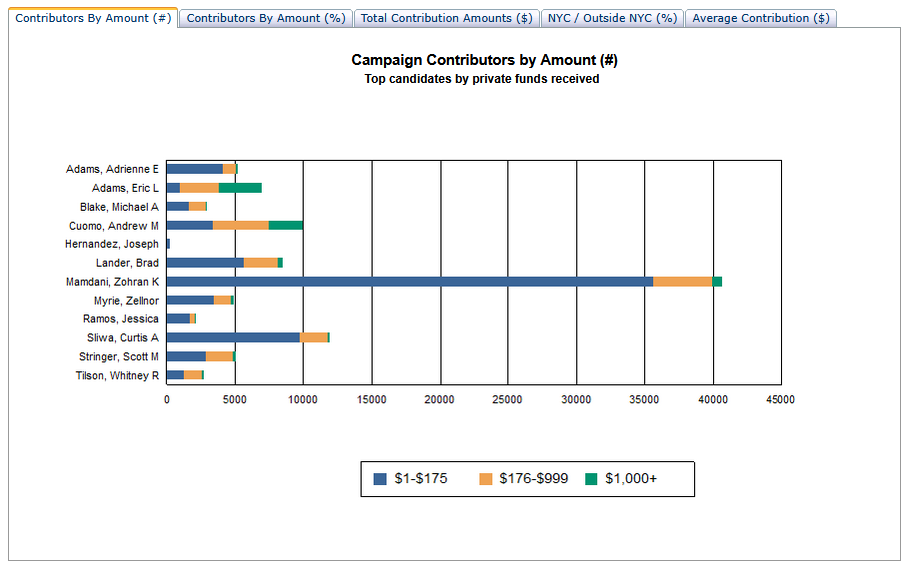
Source: https://www.nyccfb.info/VSApps/WebForm_Finance_Summary.aspx?as_election_...
The fundraising data indicates that the mayor-elect succeeded in building a diverse coalition and winning back Democratic votes that had been going to Cuomo Jr., successfully engaging various communities and political allies. This financial strategy was central to "Zohran’s Promise": the idea that a campaign funded by the working class could effectively challenge the hegemony of real estate developers and billionaire donors. In light of the strong criticism regarding Mamdani's alleged antisemitism, which has been consistently echoed in Italy as well, it is necessary to point out that many prominent New York Jewish organizations have strongly supported the Democratic candidate, some from the very beginning of his campaign. These include Jews for Racial and Economic Justice (JFREJ), Jewish Voice for Peace (JVP), and IfNotNow. Bend the Arc: Jewish Action, the largest progressive Jewish organization in the United States focused on domestic politics, gave its first historic endorsement to Mamdani in September 2025. Furthermore, just prior to the election, Mamdani received a significant endorsement from a substantial portion of the Satmar Hasidic community in Williamsburg (Brooklyn), led by Rabbi Moshe Indig.
Some of these results were achieved thanks to the political alliance he built with Brad Lander, another Democratic candidate. Lander, with his radical positions and Jewish background, served as New York City Comptroller and was one of the most vocal opponents of outgoing Mayor Eric Adams. Mamdani has always acknowledged Lander's progressive leadership role in NYC. Both candidates strategically teamed up on an unprecedented electoral ticket, leveraging New York’s Ranked Choice Voting (RCV) system, which allows voters to rank multiple candidates by preference in the primaries. Finally, the Mamdani campaign benefited from a veritable army of volunteers who carried out extensive outreach work, door-to-door canvassing, phone banking, and engagement with trade unions and local communities.
Mamdani's Identity
In his victory speech, the mayor-elect refused to apologize to his detractors on three points: for being young (although old at heart, according to him), for being Muslim, and for being a democratic socialist.
On the first point, Mamdani was heavily attacked for his young age and inexperience in public administration. This was a difficult point to refute, despite having been elected as a representative to the New York State Assembly for the Astoria district in Queens; his professional resume was certainly lighter than others. However, he compensated for this gap with the freshness of some of his ideas and, above all, with his ability to interact with people with sincerity and respect. He used the media very effectively and was much ridiculed because a few years ago he had some experience as a hip-hop artist. This type of experience, however, has undoubtedly strengthened his excellent rhetorical skills, which allowed him to humiliate the “less agile” Andrew Cuomo in television debates more than once, with exchanges that were then cleverly amplified on social media. I believe this is another element that has galvanized a part of the US Democratic electorate: hearing one of their representatives respond forcefully to opponents. The obsession with “chasing the center” and following opinion polls to appeal to the theoretical majority of the electorate without ever displeasing anyone has, in fact, led to a disheartening flattening of political debate, as was also seen in the last presidential election campaign. This, incidentally, is also one of the reasons for Trump's media success; he makes outrageous statements and does even worse things, but he is able to awaken a significant part of the American electorate from their political and media lethargy.
On the subject of being Muslim, Mamdani is clearly a secularized Muslim. This makes the alarmist rhetoric and accusations of the American right (and their European counterparts) less credible. Mamdani politically and proudly asserts his cultural identity in terms that we could describe here as Gramscian. We could even go further, analyzing his electoral victory as an example of the positive construction of what could be defined as a historical bloc. Zohran's father, Mahmood, moreover, is one of the most important contemporary post-colonial theorists and scholars and is therefore intimately familiar with Gramscian categories... There is also another aspect that has been underestimated and that is perhaps more important than his religious affiliation. Mamdani was born in Africa (Uganda), so he is technically African-American (an American of African birth), but he is primarily of Indian descent. Western media haven't adequately conveyed the great excitement and enthusiasm his election generated in South Asia. The Indian community is one of the latest waves of immigrants to the US, and his victory also represents a true social and political redemption, comparable to the significance of Fiorello La Guardia's election as Mayor of New York for Italian-Americans. The South Asian community is vast, composed of scientists, analysts, financial executives, engineers, doctors, healthcare professionals, and noted intellectuals, as well as small and medium-sized business owners. The presence of immigrants from India, Bangladesh, and Pakistan is particularly strong in New York City’s taxi industry and its "delis", the ubiquitous delicatessens that sell beverages and fresh food, often staying open twenty-four hours a day. One of the key features of Mamdani's campaign was its focus on small businesses, specifically regarding the cost of food and access to quality ingredients at reasonable prices. He also emphasized the promotion of the city's gastronomic heritage, starting with street vendors. He framed these vendors as a factor of identity and pride for many different ethnic groups and as a vital part of the local community (but also a formidable territorial network for his electoral campaign).
The third and final point is that of being a democratic socialist. The Democratic Socialists of America (DSA) is a small political organization founded in the late 1970s with the aim of uniting various left-wing socialist-inspired groups. After 1989, it also attracted some members who had left the Communist Party USA. The organization is historically characterized by a strong Jewish presence, like much of the American white radical left. It could be described as a kind of the Italian PDS/DS, with more explicit references to theoretical Marxism and less guilt about its past. The DSA left the Socialist International in 2017. Historically a small group with fewer than 10,000 members, its ranks grew to 20,000 in recent years. In the last year, at the end of the Democratic primary campaign in NYC, its membership quadrupled, reaching 80,000 members. The DSA participates in the Democratic primaries by fielding its own candidates or explicitly supporting candidates it deems aligned with its program. For example, Bernie Sanders, who identifies as a democratic socialist, is not a member of the DSA, but receives its support. Alexandria Ocasio-Cortez, elected to the House of Representatives in New York, is a member, along with three other elected members: Rashida Tlaib (Michigan), Cori Bush (Missouri), and Jamaal Bowman (New York). The Democratic left and the DSA are also doing significant work in building a base in workplaces and unions, offering support and organizational assistance for the unionization of non-unionized workers. Finally, this is not the first time that New York City has elected a mayor who is a member of the DSA. In fact, David Dinkins, the city's first African-American Mayor, elected in 1989, was a member of the organization, although this was not widely publicized. Dinkins was always considered a pragmatist and in his later years officially distanced himself from the DSA, without ever being hostile to the democratic socialist left. Even in those years, voter turnout and political polarization were very high, and Dinkins, after the economic crisis of 1991, lost his re-election in 1993 to Rudy Giuliani by only 50,000 votes. Trump's future lawyer conducted a ruthless election campaign, exploiting racial tensions and shamelessly riding the wave of a veritable revolt of approximately 4,000 New York City police officers. During the protest, many of whom were reportedly intoxicated, attempted to storm City Hall, shouting "Take the Hall!" (does that sound familiar?), in protest against the Mayor's proposal to create a civilian agency to investigate police misconduct.
The challenges facing the new mayor
In light of these precedents, Mamdani will face very difficult challenges. The two main issues before him are financial instability, linked to the performance of the City's municipal bonds, and the power of the State of New York to veto city taxes. Democratic Governor Kathy Hochul, who has declared her support for Mamdani, has expressed reservations about the proposal to increase taxes on wealthy residents to finance certain public services (for example, transportation and childcare).
Furthermore, during the election campaign, Trump threatened New York City residents with retaliation should they elect a socialist mayor, starting with cutting federal funding to the city. We also know that he is ready to play the militarization card, sending in the National Guard and Immigration and Customs Enforcement (ICE) agents, even without valid reasons, to provoke institutional conflict and an escalation of violence. For now, the enthusiasm surrounding the new mayor is understandably still high: in the week following the elections, more than 50,000 people submitted resumes to the institutional transition committee appointed by Mamdani, offering their services to the new administration that will officially take office on January 1, 2026.
One of the lessons that can be learned from his election is that the left can win, not only in New York City, when it manages to broaden the scope of democratic participation by committing to improving the present. During the long election campaign (primaries and general election), Zohran Mamdani managed to become the unifying force of a broad and diverse coalition and made many proposals, almost all pragmatic but which many consider difficult to implement. He will have to face these governing challenges at one of the most complicated political moments in recent US history. For now, Mamdani has adopted a "responsible" approach; for example, he said he wants to retain the Police Commissioner appointed by his predecessor Adams, and he held a cordial meeting with Trump at the White House. His political and personal profile has united and given hope to many different identities, who have found in him a reflection of their own history and aspirations. Mamdani has indeed appeared as an immigrant but perfectly integrated, he is African and Indian, he is a nice guy whom even grandmothers like, he is Muslim but not Arab, he is consistently polite but capable of responding sharply to the insults of political opponents, he shows respect and empathy for the humblest people, not detachment from the daily problems of citizens; he often expresses ideas that one may or may not agree with, but on which people can at least reflect and form an opinion, and in these times, that's no small feat.
Democratic Victories in Other Cities and States
In concluding this analysis of the New York City elections, it may be useful to add some information about other city elections that have taken place in recent weeks.
In Detroit, Mary Sheffield was elected Mayor with 77% of the vote, defeating Pastor Solomon Kinloch Jr., whom she had also beaten in the previous Democratic primary. Although voter turnout was lower than in NYC, there was also an increase in votes compared to the last election. Sheffield had received the support of many unions, social organizations, Baptist churches, and outgoing Mayor Mike Duggan, who was elected for three terms after the city's bankruptcy and has already announced his candidacy for governor of Michigan in next year's elections. Pastor Solomon Kinloch, leveraging the support built through his pastoral work, received the endorsement of the UAW (United Auto Workers), a symbolically important endorsement in the Motor City. Under his leadership, Triumph Church, starting with just a few dozen members, has grown to a congregation of approximately 40,000 people. The presence and deep roots of Protestant missionary churches in Detroit's neighborhoods will be a topic to be analyzed further.
In other major cities where elections were held, all the Democratic mayors were elected or re-elected: Andre Dickens in Atlanta, Georgia; Michelle Wu in Boston, Massachusetts; Justin Bibb in Cleveland, Ohio; Jacob Frey in Minneapolis, Minnesota; Bruce Harrell in Seattle, Washington. Additionally, the Democrats secured governorships in two states. In New Jersey, Mikie Sherrill was elected, succeeding outgoing Democrat Phil Murphy. Here, the Republicans had hoped to win the state on the back of Trump's election. In Virginia, Abigail Spanberger, a Democrat, former CIA officer and congresswoman, wrested the state from Republican control, even though Trump had lost the presidential election there last year.
The strength of the Democrats in urban areas is nothing new, but a truly remarkable development was the election, for the first time since 2005, of a Democratic mayor in Miami. This is particularly significant because Florida (where Obama, for example, won the presidential elections twice), under the leadership of Ron DeSantis, is becoming one of the bastions of US conservatism. Voter turnout was low, but higher than in previous elections, and the victory was achieved in the runoff. In a city of approximately 450,000 inhabitants (excluding the metropolitan area of over 2.5 million), about 35,000 people voted in the first round, compared to a historical average of around 25,000 voters. In the first round, Higgins had still obtained 13,440 votes on her own, which was the sum of the votes of the three Republican candidates who ran separately. In addition, there was another Democrat candidate (6,500 votes) and an independent candidate (1,800 votes). In the runoff, Eileen Higgins obtained 59.5% (22,100 votes) against 40.5% (15,100 votes) for the Republican candidate. All the Republican mayors elected in the last four terms had obtained between 20,000 and 25,000 total votes without ever having opponents who managed to galvanize support for an alternative political platform. In a city where the percentage of residents of Ibero-American origin is approximately 70%, the persecutory policies against immigrants implemented in the last year by the Trump administration probably did not help the Republican candidate.